

Thypoch has been pumping out new lenses for Leica M-mount regularly for the past year, and while there are certainly digital cameras that they work great on, I think the company knows its biggest market is probably going to be analog fans.
While yes, I do still have sharpness tests done on our PetaPixel test chart (thank you, Chris Niccolls), the samples below were all taken using both lenses on my Voigtländer Bessa R2a. This is also going to be a bit more of a free-flowing review than is typical for us since it combines two very different lenses into one. Let’s start with the $700 Thypoch Simerea 28mm f/1.4.
Thypoch Simerea 28mm f/1.4 Review: Build Quality
I really like the build quality of Thypoch’s Simera series. We’ve tested a few of the company’s lenses now and these always impress with solid metal construction, a decent heft, and mostly excellent design choices. I say “mostly” because for a time, Thypoch decided to include a locking switch that would automatically engage when the lens was focused to infinity. While this certainly has fans, I (along with the rest of the PetaPixel team), found it to be more of a hindrance than a help. We can’t have been alone, since the company chose to change the design of all of its Simera lenses this year away from that switch and over to a thumb rest. I got a chance to feel this change for myself with the 75mm f/1.4 and I much prefer it so I’m glad to see that Thypoch is going to continue this choice for the 28mm f/1.4 too.

The top of the lens features a clever and very pretty depth of field gauge and there is a click and de-click switch for the aperture ring. When focusing the lens, there is a slight detent that you’ll feel as you get to the close focus of the lens, and that lets you feel when you’re getting too close to a subject to focus with a rangefinder. Videographers like Jordan Drake — who shot with the lens while filming a recent episode of our YouTube show so that he could provide me some feedback on it — will not like this at all, meaning it’s probably not a particularly great video lens.


That’s a shame, because the one type of user who might like this lens is a videographer since none of the Simera lenses — of any of Thypoch’s lenses, for that matter — feature an electronic connection with a camera, although they are coupled to M-mount rangefinders. This means that while it’s not necessarily the best choice for mounting on most modern digital cameras despite the ease of adapting M-mount, it is a great choice for film fans.
Thypoch Simera 28mm f/1.4 Review: How It Shoots
It’s hard to complain about the Simera 28mm f/1.4 when shooting on film. Images are well rendered, although I will say that it’s difficult to see any “character” out of the lens. That may be because of the focal length, but I was rarely blown away with bokeh or focus falloff. There is the occasional hit where a photo just has a ton of vibe, such as the portrait of Chris on the train below, but for the most part, 28mm feels like a setup shot focal length, where you’re just seeing a scene. Not quite what I would call ultra-wide, but too wide to really focus on anything in the frame, if you catch my meaning.






Flare is moderately well-controlled. I noticed a loss of contrast right around point light sources and there is some ghosting present. That said, on film, it doesn’t really play a major role in how I feel about a photo.





What is nice about the 28mm f/1.4 is its ability to give me a bit more latitude with light-gathering capability in the early morning or at night. I did find myself wishing for just a hair more light, probably more me yearning for my favorite Voigtlander 35mm f/1.2, but I think it performed well considering how dark it was and how my film wasn’t particularly fast.




Now that I’ve given you a large set of sample photos so you have an idea of what you can expect, let’s take a look at our more clinical test shots. These were captured on a Sony a7RV using an M to E adapter, which means they’re not going to be perfectly indicative of the lens’ performance on native cameras but it’s certainly a better look than I can give you with film alone. The 28mm f/1.4 has pretty good sharpness in the center wide open, but that falls off pretty quickly on the edges which are downright smudgy. That cleans up a lot when stopping down to f/2.8, but I don’t think I would call those corners “sharp.” They’re pretty poor.
I am pretty happy with the sharpness in the center, however, especially if you’re able to stop down a bit; doing so will also bump up the contrast nicely. The Simera 28mm f/1.4 is capable of rendering some very nice detail.


The lens also has a little bit of longitudinal chromatic aberration, or LoCA, but it’s not awful. LoCA is when there is a color shift between foreground and background out-of-focus areas, and it is very difficult to get rid of in post-production.

The 28mm f/1.4 shows a pretty typical magenta-green shift, but it’s not the worst I’ve seen and you probably won’t notice it if you’re shooting film. However, it is worth keeping in mind. One last thing to note is that in lab testing, we found that lens to be closer to f/1.7 than f/1.4, which isn’t terribly unusual but something we feel is important to point out.
Thypoch Eureka 50mm f/2 Review: Build Quality
Switching over to the $479 Eureka 50mm f/2, there is a lot to talk about. Firstly, this lens is very different from the Simera series in that at the time of publication, there is only one lens in Thypoch’s Eureka line: the 50mm f/2. Secondly, it’s a wholly different kind of lens.

The Eureka 50mm f/2 is a collapsible, compact optic that is heavily inspired by the Taylor-Hobson Anastigmat 50mm f/2 from 1951. This is a very small-batch production lens originally designed for Leica screw mount but Thypoch has done its best to bring this unusual optic into the 21st century. When collapsed, the 50mm f/2 is the size of a pancake lens at 2.7 centimeters long. When pulled out and twisted into a locked position, it about doubles in size but is still a quite compact 4.12 centimeters.
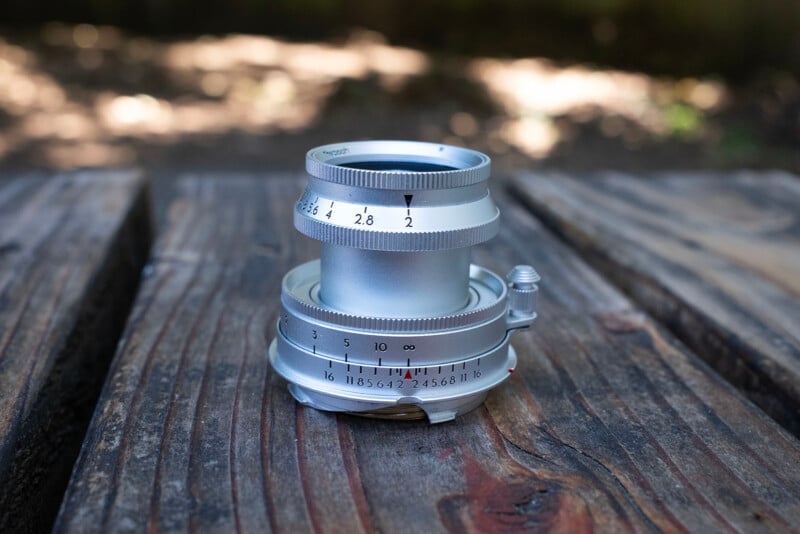
Thypoch says it did its best to recreate the Taylor-Hobson glass formula one-to-one, which is nice. It’s basically the company’s attempt at something Light Lens Lab does all the time, and I applaud it. It is also, wonderfully, rangefinder coupled.
I’ve always had a hard time trusting an optic with a big moving part like this, but there isn’t really a reason for me to feel this way. Telescoping or retractable lenses have been a thing for a long, long time and there are countless examples of them being great.

One notable difference between the Eureka and the Simera series is that while Thypoch removed that locking switch from the focus ring on the latter line, it did not and will not be removing it from the Eureka. The company didn’t say why, but I imagine it is because this lens is actually based on a historical lens, and removing that locking switch would feel like they were doing a disservice to the optic that inspired it. Oddly, I didn’t find the locking switch to bother me as much on the 50mm f/2 as it does on the Simera line, so I’m good with it sticking around.

There are basically no controls on this lens given its small size. The aperture can’t be toggled (it is always de-clicked) and the front element is so small that there aren’t any screw-on filters that work with it. Only over-lens filters are an option, but those are not common and are a hassle to use. Speaking of that, instead of a typical clipping lens hood, Thypoch ships the Eureka 50mm f/2 with a small aluminum cap that uses friction to stay in place.
Thypoch Eureka 50mm f/2 Review: How It Shoots
I adore this lens. I ended up liking the shooting experience with it far more than I would have expected. Typically, 50mm isn’t my favorite and I didn’t think I would enjoy the push-pull telescoping design, but I used the 50mm f/2 more than I used the 28mm f/1.4.


The only thing I can say about the experience that took some getting used to was remembering when I had collapsed it. Sometimes, I would reach down to take a photo and realize I hadn’t pulled the lens out, which lost me a shot. It didn’t happen a ton, but enough that I recall the feeling of disappointment. That’s wholly user error of course but will be something you’ll have to keep in mind if you pick up this lens.


It’s fast, easy, and just a blast to use on the street. I found the images it renders to be very pretty, with sharp focus on the subject and a beautiful falloff into the out-of-focus areas. Bokeh is nice and round and pretty easy to get thanks to the tighter “normal” focal length.




50mm is more versatile than I think some photographers, myself included, give it credit for. Especially through a rangefinder where I can see an area around the frame of view, 50mm felt really good for portraits, street photos, and even cityscapes.


In a controlled lab test, I think the performance of the Eureka 50mm f/2 is even more impressive, especially given its small size and unique design. Starting with LoCA, there is some present but it’s pretty minor. I think that given the constraints of the lens design, this is a fantastic result. Sure, there is a bit of that magenta-green split, but it’s less pronounced than in the Simera 28mm f/1.4 example above.

Looking at sharpness, I’m again impressed. In the center, the 50mm f/2 is decently sharp wide-open, but contrast and sharpness both improve substantially when stopped down to f/4.


In stark contrast to the results with the Simera 28mm f/1.4, the Eureka 50mm f/2 is quite nice in the corners, even wide open. Stopping down improves things once again with more sharpness and significantly less vignetting, but I would feel comfortable recommending using this lens wide open.


Perhaps more interesting is how flat this lens is. Even when we were focused in the center, the corners were still pretty sharp, which is a great result. Despite its unusual design and small stature, the Eureka 50mm f/2 is a really nice little lens.
It’s not all good news though. Old lens designs are odd and this is no different: when the corners are in focus at f4 the center goes totally out of focus just in the very center. Strange!
Thypoch Simera 28mm f/1.4 and Eureka 50mm f/2 Review: Great Options for Film Fans
There is a distinct lack of what we call “gap primes” on the market, especially brand-new. That’s why I feel comfortable recommending the 28mm f/1.4 even though it’s not the best performer across the board. If you don’t want to buy a Leica and can’t find a Voigtlander at a price you like, then the Simera 28mm f/1.4 is a solid alternative. I wouldn’t say you should reach for it first, but it’ll be there for you if the other options remain out of reach.
The 50mm f/2, however, is one I would say is definitely worth picking up. Not only is it nice to have such a small and lightweight lens, but it’s also a solid performer. I found myself wanting to come back to it time and time again and I genuinely enjoyed using it.

Are There Alternatives?
Starting with the Simera, 7Artisans has a 28mm f/1.4 for $459, which several hundred dollars less than the $700 price Thypoch is asking, but I can’t speak to the quality since I’ve never used it. Voigtländer has a 28mm f/1.5 Nokton Aspherical for a hefty $1,000. It is otherwise difficult to find non-Leica, new 28mm lenses.
Finding a comparable option to the $479 Eureka 50mm f/2 is even more difficult given its unusual design. It’s one of a kind right now and, I argue, very well priced.

Should You Buy It?
Splitting the recommendation, I would say the Simera 28mm f/1.4 is a solid “maybe.” It’s not a top performer, but it looks nice, feels good to use, and is relatively affordable. On the other hand, the Eureka 50mm f/2 is a heartfelt “yes.” It’s a very sharp lens with exceptional character and a unique design that will put a smile on your face.