
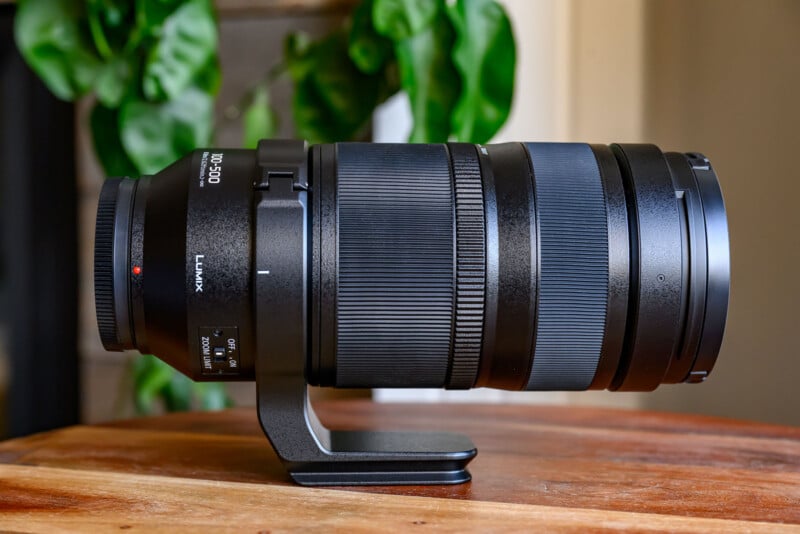
For the last several years, if you were an L-Mount user looking for a super telephoto lens, Sigma was your only option (or a Leica version of a Sigma lens). Now Panasonic has introduced their longest full frame lens yet, with the Lumix S 100-500mm f/5-7.1 OIS. It’s compact and light, but also slow and expensive. Is there a place for this $2,100 lens in the L-Mount lineup? Let’s find out.
What reignited my interest in reviewing this lens was a recent trip to Costa Rica, shooting with Micro Four Thirds. Their excellent stabilization allowed me to shoot video of birds handheld with lightweight 400-600mm equivalent lenses. I was interested in a similar experience with the Panasonic S1 II, and the Lumix S 100-500mm f/5-7.1 looked like the best option that combines reach, portability and stabilization.
How It Feels
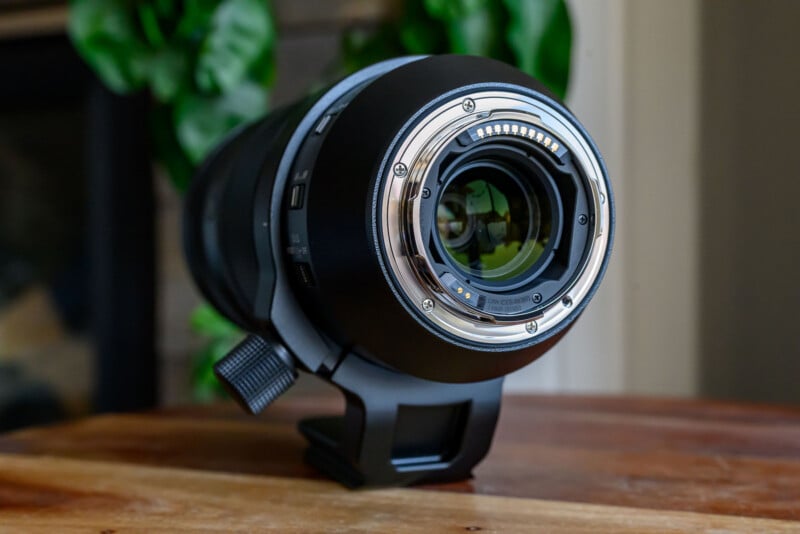
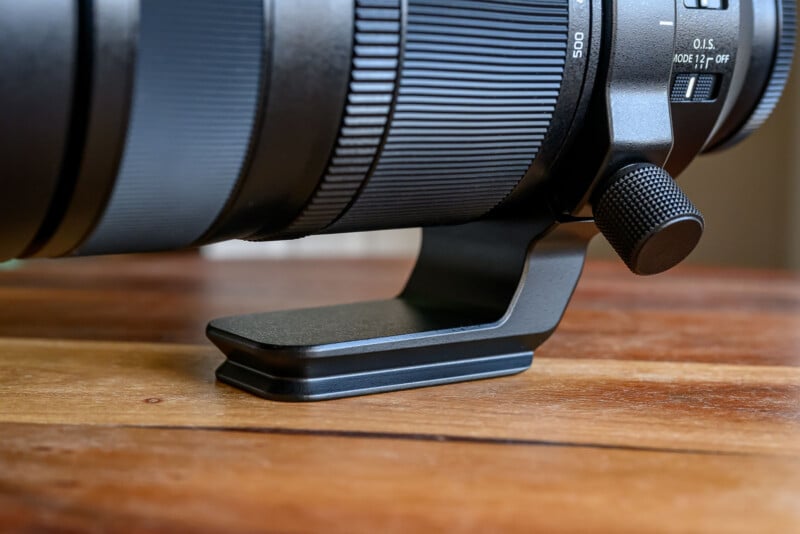
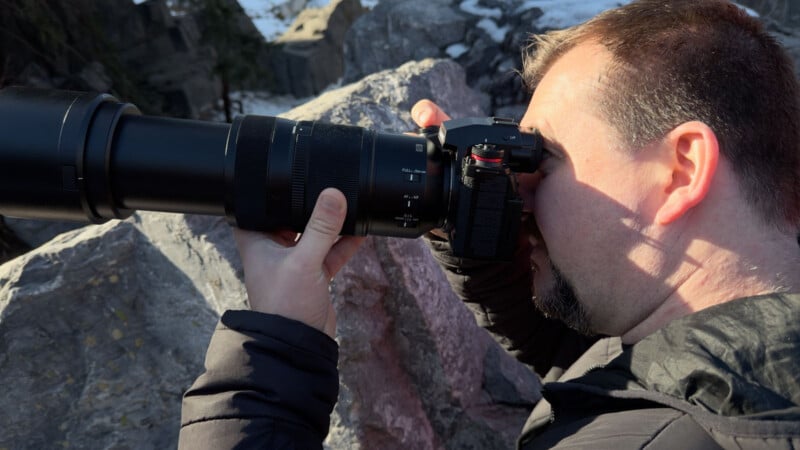
One of the standout aspects of this lens is its portability. The size of a 70-200mm f/2.8 when collapsed, it weighs in at only 1285g (2.8 lbs.) without the hood or collar attached. Also, unlike many super telephoto lenses, it accepts common and affordable 82mm filters. Build quality is excellent, with well damped focus and zoom rings. There is a ring to adjust the zoom tension, but I found the “Smooth” setting offered a good amount of resistance. I like having this function though, as you will be able to tighten up the zoom ring as it loosens over time.

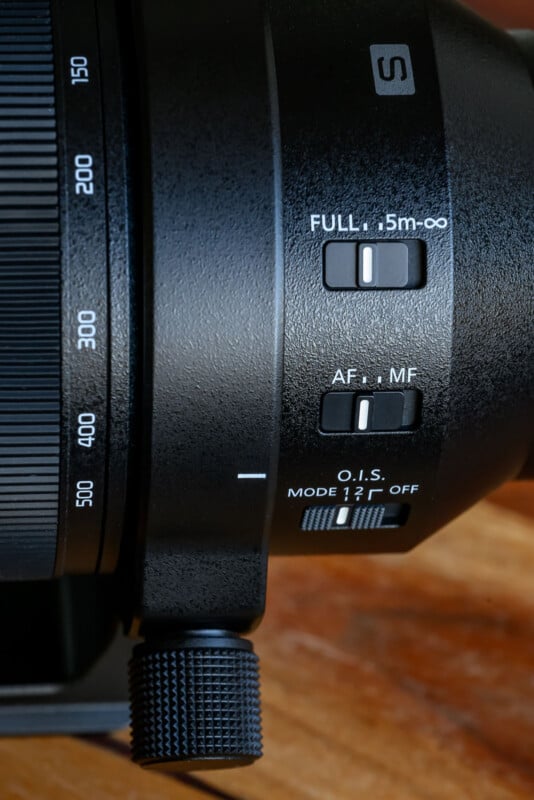
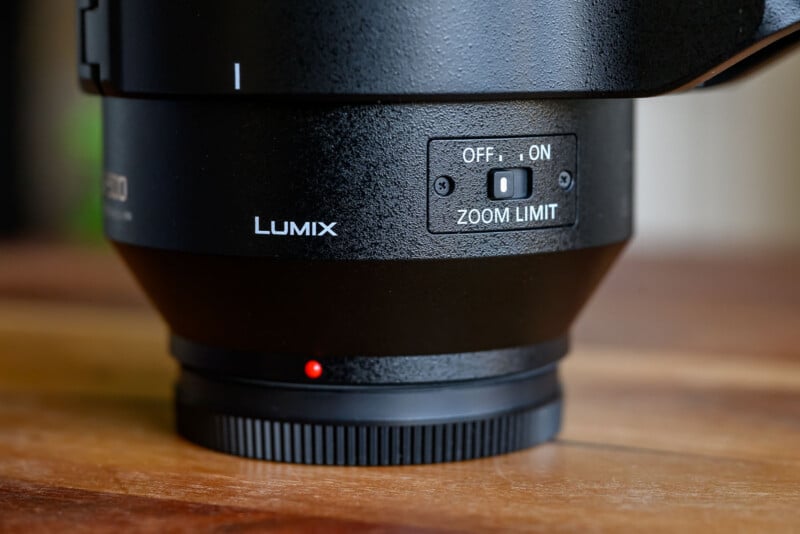
All of the standard controls can be found on the lens barrel, including an AF/MF selector switch, focus limiter, custom button and stabilization mode selector. One uncommon option is located on the oppohttps://creatorkitdepot.com/ side, a “Zoom Limit” switch. This must be enabled when using teleconverters (both 1.4x and 2x are supported), and it prevents the lens from zooming below 150mm and banging against the converter. This is a great way to allow teleconverter use without extending the length of the back of the lens. However, remember to disengage this switch when teleconverters are removed, as you will lose the ability to zoom back to 100mm.
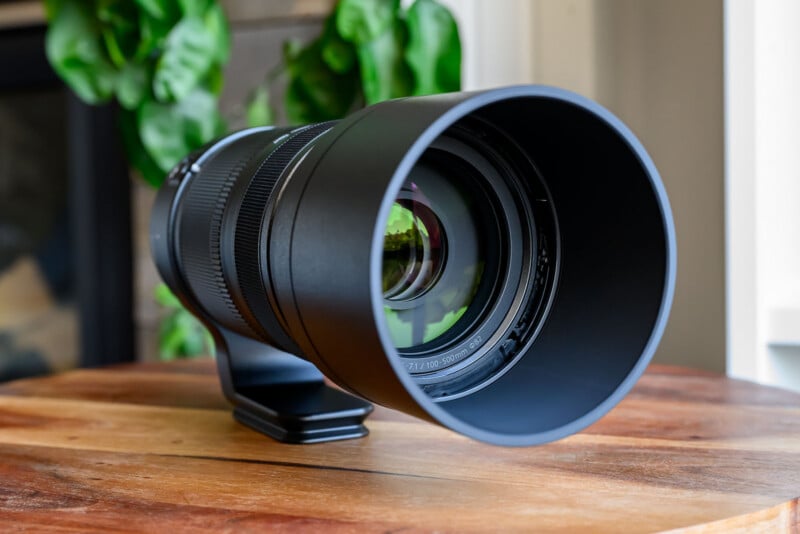
As this is a professional ’S’ series lens, it is weather sealed, and includes both a well built locking hood, and easily removable tripod collar with arca-swiss cutouts. While build quality and accessories are usually scaled back on variable aperture, slower lenses, Panasonic has thrown all their best technology into this optic.
How It Shoots
This lens utilizes dual linear motors, resulting in extremely fast and silent autofocus performance. Focus shifts from close up to infinity almost instantaneously, so the motor will never be the limiting factor when shooting wildlife and sports.
The stabilization was the most interesting aspect of this lens for me. When combined with a Panasonic S-Series body, the lenses built in OIS and camera’s IBIS enable “Dual 2” stabilization, which I’ve found extremely effective on shorter lenses. This lens is rated at 7 stops of stability in the middle of the frame when used with Lumix cameras, and I found it to be the best stabilization I’ve tested on a full frame body.

Furthermore, when shooting video handheld, the footage is extremely well stabilized but avoids the unnatural jerkiness other systems demonstrate when panning or tilting. I would have no concerns about shooting wildlife and sports video handheld with this lens, something I never say about full frame super telephotos.
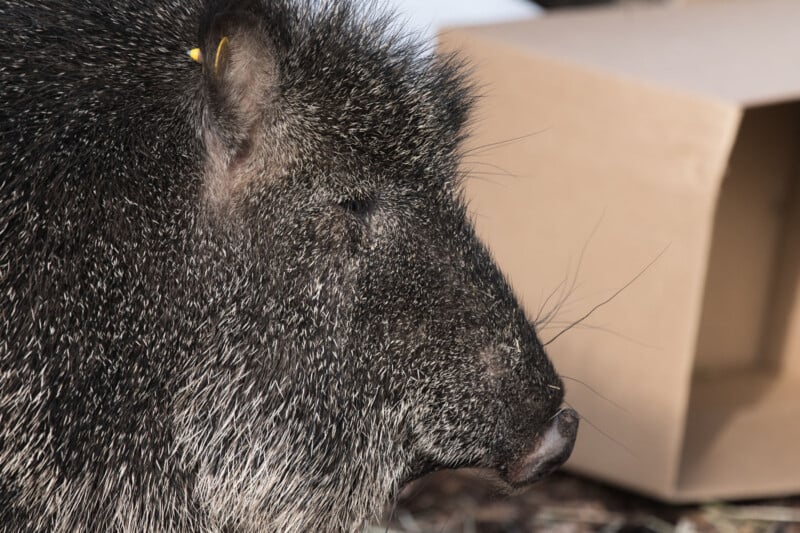
Generally telephotos don’t excel at capturing subjects close-up, but this lens is interesting in its ability to capture subjects at 0.36x magnification. Usefully, this ability is found at the 500mm range, giving photographers plenty of working distance if you want to capture dangerous insects or animals up close.

Lens breathing, where the field of view changes as focus shifts from close-up to infinity and back again, can be a concern for videographers looking to utilize this lens. There is definitely some breathing at both ends of the zoom range, but it is most noticeable for extreme pulls from near to far. When shifting focus at the longer distances usually required by telephoto lenses, breathing will be very minor.
Flare control is excellent when shooting towards the sun. There is a very minor loss of contrast, but almost no distracting ghosting. Simply put, if a bird or athlete passes in front of the sun while you’re shooting, this lens will still provide contrasty, usable images.

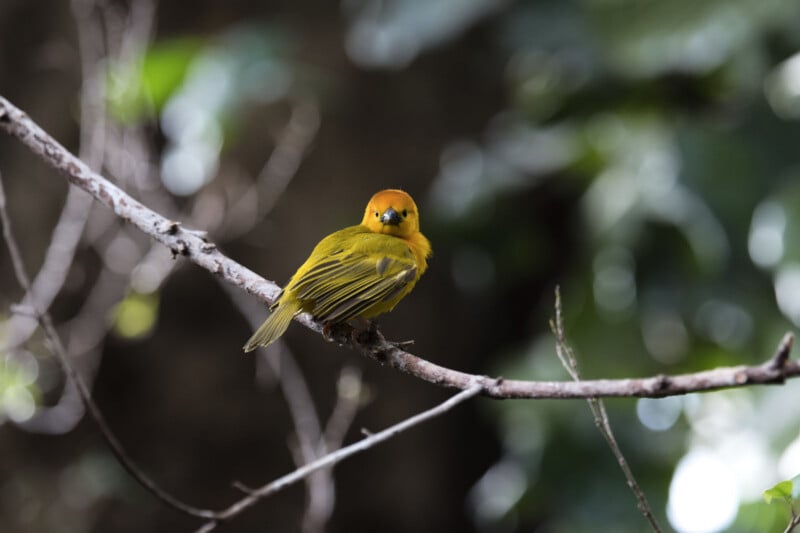
I usually don’t expect nice bokeh on a variable aperture super telephoto lens, but this lens impressed me. Specular highlights are devoid of distracting onion rings, and while a soap bubble effect can be occasionally seen, it is very minor. This translates to very smooth backgrounds, and a pleasing transition from in focus to out of focus areas.


In terms of sharpness, this lens is a very strong performer in the middle of the frame. At both 100mm and 500mm it delivers plenty of detail, and not a huge benefit when stopping down. This is valuable, as this optic is already pretty dark to begin with.

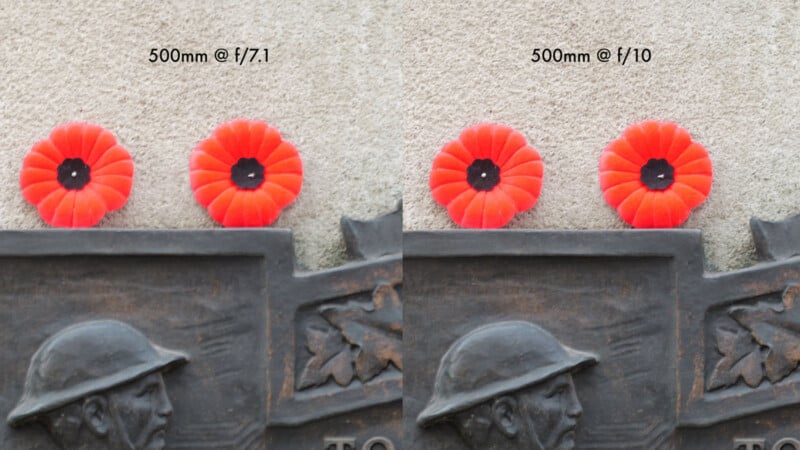
Corners are noticeably worse than the center at both ends of the zoom. While there is some improvement when stopping down, corners are never tack sharp. For maximum sharpness, it’s worth keeping your subject in the central region of the frame. That said, these tests were conducted on the 45-megapixel S1R II, the lens will out-resolve most 24-megapixel cameras, which make up the majority of the L-Mount camera catalogue.
The Panasonic Lumix S 100-500mm f/5-7.1 O.I.S. Is Impressive But Not for Everyone
The Panasonic Lumix S 100-500mm f/5-7.1 O.I.S. is an impressive compact, portable lens with excellent stability, which makes it a great choice for wildlife and sports videography. However, the lens’ aperture is undeniably on the slower side, which can limit its appeal for wildlife photographers.
The L-Mount system is also fairly crowded in the slower telephoto zoom category, with Sigma offering both 100-400mm and 150-600mm zoom lenses that arguably have more appeal than Panasonic’s new lens for some photographers, while also being more affordable.


Nonetheless, there is a lot to like about Panasonic’s new zoom, besides its form factor and excellent stabilization. The lens is quite sharp across much of the frame at both 100mm and 500mm, and it also offers nice, clean bokeh despite its slower aperture. It’s not that it’s a bad lens by any stretch, but its limitations mean it’s not an easy sell for everyone.
Are There Alternatives?
As mentioned earlier, the only other L-Mount options for dedicated super telephotos are produced by Sigma. Their $1,100 100-400mm f/5-6.3 DG DN OS Contemporary is a similar size and weight, and a third of a stop faster at the telephoto end. However, it is 100mm shorter and has less effective autofocus and stabilization technologies. That said, it’s essentially half the price of the Panasonic!
The $1,650 Sigma 150-600mm f/5-6.3 DG DN OS Sports is another strong option, giving more reach, a brighter maximum aperture and similarly excellent build quality. It boasts excellent autofocus and solid stabilization, though not as effective as Panasonic’s system. However, the Sigma is nearly twice the weight, and substantially larger making it less appealing for travel and handheld work. It is significantly more affordable than the Panasonic though.

Should You Buy It?
Maybe. If your top priorities are portability and stability, with an emphasis on video, the Panasonic Lumix S 100-500mm f/5-7.1 OIS offers an unbeatable package. If you are a photographer willing to sacrifice either zoom reach or portability, the Sigma alternatives offer fantastic optical performance for a lower price.