
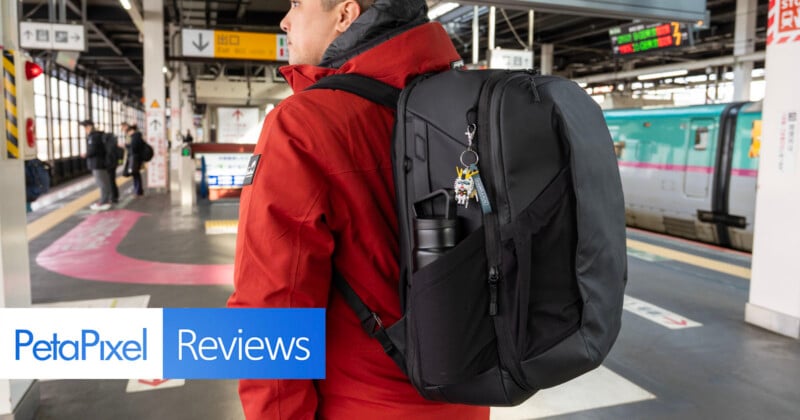
In 2018, I reviewed the Peak Design Travel Backpack for Imaging Resource and while that review has since disappeared from the Internet, I can still recall my feelings in extreme detail: I hated it.
But now, eight years later, Peak Design appears to have learned from at least some of its mistakes. While it isn’t discontinuing the original Travel Backpack, we have a new addition to the line that I argue is significantly superior to the original: the $399.95 Travel Backpack 2-in-1.
Author’s Note: At the time of publication, the Peak Design Travel Backpack 2-in-1 was available to back on Kickstarter, but it will be widely available at other retailers after launch. Make sure you do your own research into any crowdfunding project you’re considering backing. While we aim to only share legitimate and trustworthy campaigns, there’s always a real chance that you can lose your money when backing any crowdfunded project. PetaPixel does not participate in any crowdfunding affiliate programs.
Peak Design Travel Backpack 2-in-1 Review: Design and Build Quality
Peak Design didn’t change much about the design language of this new 2-in-1 backpack versus the original. It’s still a rather homely black blob without much else to speak of. I guess I can come right out and say it: it’s ugly.
But I also don’t get the sense that Peak Design was going for something that was particularly showy. This is a bag for carrying things, not for impressing passers by on the streets of New York City. It is most certainly function over form.
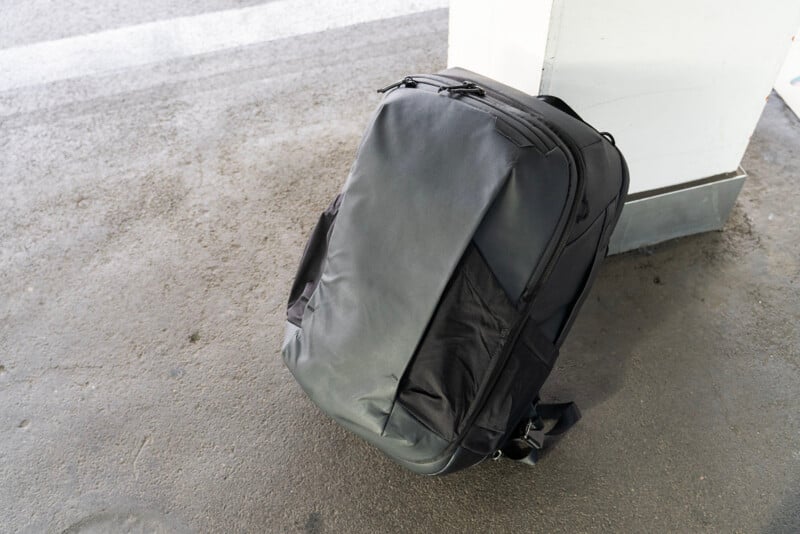
Peak Design tends to pick certain super durable materials that are rugged — don’t get me wrong — they’re just heavy. That continues to be the case here, as the Travel Backpack 2-in-1 does have some heft even when empty.
My biggest complaint with the original Travel backpack was that not only is it just a giant, cavernous sack, but it is also extremely uncomfortable to wear for long periods, especially when filled with camera cubes. With that bag, you’re basically forced to just throw in cubes willy-nilly and hope for the best.
With this new bag, I repurposed the same Peak Design hard-sided camera cube I have in the larger Peak adventure bag line, and it fit perfectly. It secures in place with the same hook and clip system that the other bags use too. With the large camera cube inserted, I still have room at the top of the space to stash my Tech Pouch, which is also Peak Design (and is still my favorite thing the company has ever made).
The 2-in-1 has a 40L total capacity when used as a single backpack, which is the maximum size for an international carry-on. I can confirm I have successfully stowed it in the overhead bins without problems in international economy class. The “trick” with this bag is that it can separate into two bags. The back unzips and separates from the main unit, leaving a 34L base pack and a 16L zip-off day pack that can be used when you get to your destination.
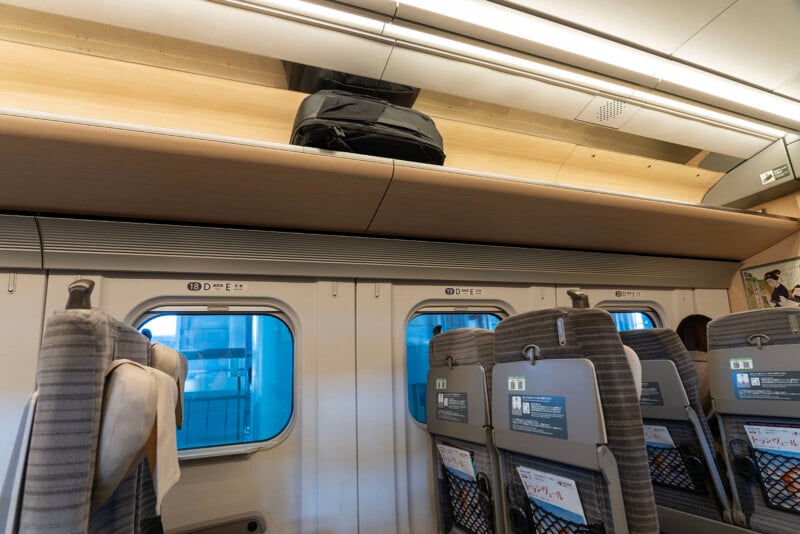
I’ll come back to that point because my next few comments delve into the “in-use” section. Sticking with design and build quality, Peak Design did a great job with this backpack. It has great ideas, is made well, and is comfortable to wear.
The straps are a huge step up from the other Travel bag and actually contour to your shoulders, with a thick, robust feel that matches how much weight you’re likely to be carrying. Those straps magnetize to the back of the bag when you’re not wearing it, which just has a satisfying sense of tight and clean design.

It has a roller bag handle strap too, so you can wheel it to and from the airport. It even has hidden waist straps, although I haven’t needed to use those. There are so many pockets and compartments on this bag that I was spoiled for choice. This is a serious step up from the last travel bag in basically every regard.
Peak Design Travel Backpack 2-in-1 Review: In Use
The only complaint I have is that it’s very easy to fill this bag with a lot of gear, and as a result, it gets very heavy quickly. I guess that is more of a “me” problem than a Peak Design one, and it comes with the territory when you make a bag this big. Just get ready to have a lot of weight on your shoulders, so I don’t recommend this for all-day use. Just get to your place of rest, then transition your kit into another bag for the day.
On that note…

Let’s loop back to the 2-in-1 design, specifically with the smaller day backpack. I like this idea a lot. I’ve shown it to a few people, and the first reaction is an audible “whoa” when they see it. The idea is brilliant, but the execution is a bit wanting.

Let’s be real: this is a product that photographers are going to buy. Peak Design might be expanding beyond the creative industry to become a more general consumer carry brand, but its core remains photographers and filmmakers. With that in mind, the day pack is woefully inadequate for carrying a camera. It’s fantastic if you just want to hold a water bottle, a jacket, and other necessities, but it stinks at carrying anything fragile.
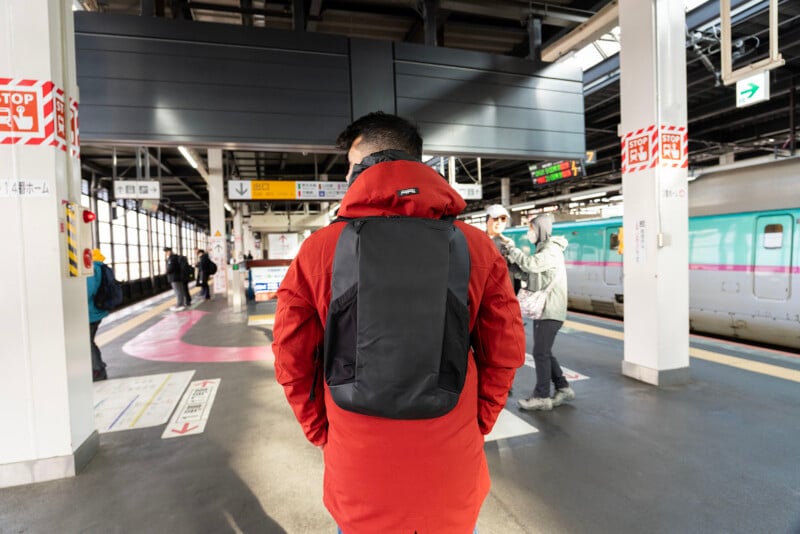
That’s unfortunate, because it would be awesome to have a great, large bag rig for getting all my gear to a destination, as well as a smaller bag that lets me bring one camera and a lens out for a day of leisure. I don’t know about you, but when I travel internationally for work, I do try to set aside a few hours of personal time to enjoy where I am, but I still want to carry a camera with me. I’ve done it with this smaller daypack, but it’s been unpleasant.
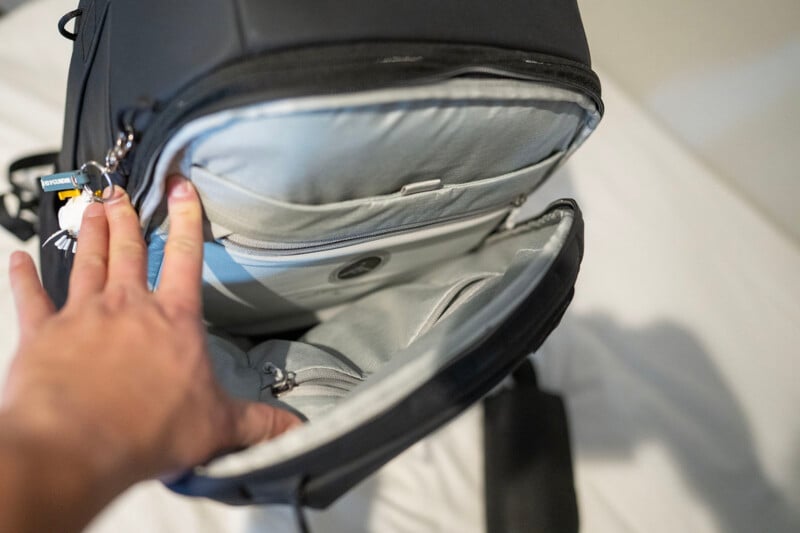
The smaller bag has no support for dividers, so anything you put in it just bounces around and bangs into whatever else you have in there. It’s also just a hair too thin to really comfortably hold a camera, so you’re going to feel it poking into your back. The support straps are also pretty flimsy, but given that it’s a bonus bag, I was willing to overlook that part; it’s still comfortable to wear for long periods of time. It’s the weakness in carrying photo gear that really sticks out to me.
Overall, the usability of the main bag and the bonus flexibility of the daypack feel worth it, even if the latter is not close to as good at its job as I had hoped.
Peak Design Learned From Its Mistakes
As I said at the start of this review, I absolutely hated the original Travel Backpack. I am really happy to report that Peak Design seems to have taken my (and others’) complaints to heart and addressed as many of them as it could with this new 2-in-1.
It has its flaws still, but after two international journeys with it on my back, I think it will probably accompany me on many more — at least those that require a larger amount of gear, such as for a video production or if I’m feeling particularly ambitious with my film photography. At $400, it’s not absurdly more expensive than other bags of its size, and the built-in flexibility is a nice add-on.
The issue I have, and others may agree, is that it’s not necessarily a great thing that a bag can carry everything, because then you’re going to bring everything. I think Peak Design’s 2-in-1 does make this mistake, as it’s so big that I found myself filling it with things I probably could have left at home if I were forced to make choices. Still, have I been glad to have those things with me? Yeah, probably.
Are There Alternatives?
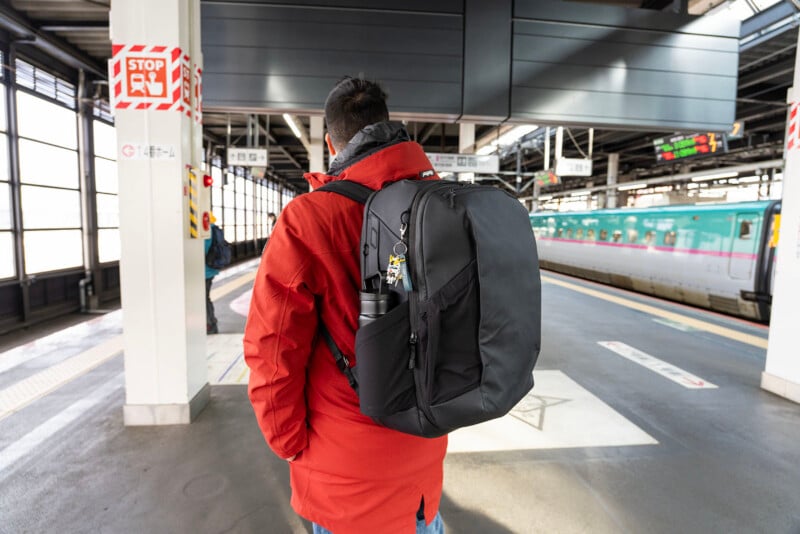
I have never seen the 2-in-1 design before, although it would not surprise me if it was out there somewhere. The combination of a photo bag with this feature is unique, though, and so there isn’t anything I’ve seen or tried that does the same thing.
That said, if you don’t care for that aspect, there are tons of other bags out there that are useful for carrying gear internationally. Shimoda, Wandrd, and Moment all have great options in that regard.
Nomatic’s Peter McKinnon bags look very similar to what Peak Design has created here, and the larger ones have a pretty similar carry capacity, too.
Should You Buy It?
Yes. If you like what the Peak Design Travel Backpack 2-in-1 offers, it delivers on that promise. It’s made very well, has tons of pockets and storage capacity, and is gratefully comfortable (if not a bit heavy), even when packed to the brim.