

The Pixless Camera is a new compact, retro-inspired digital camera that transforms everyday photos into playful, Game Boy–style pixel art. Photographer Mathieu Stern recently got his hands on one and put it through its paces to see how it performs.
The Pixless, which launched through a Kickstarter project, has been drawing attention for its unusual approach to image-making. At first glance, it doesn’t look like a conventional camera at all. With its toy-like design, chunky buttons, and compact size, it seems closer to something a child might pull out of a drawer of forgotten electronics than a piece of modern imaging equipment. Yet that quirkiness is exactly what has made it appealing to photographers and enthusiasts curious about alternatives to the megapixel race.
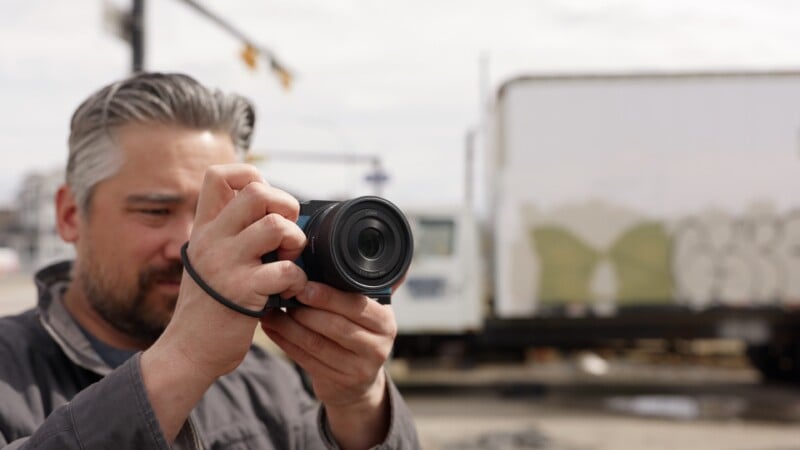
Photographer and filmmaker Mathieu Stern recently featured the Pixless in the 8-minute YouTube review above, framing it as a device that feels like it could have come straight from Nintendo’s experimental years of the 1990s.
“A Game Boy–like camera that’s playful, strange, maybe a little hard to use, but surprisingly fun,” Stern said.
For Stern, the Pixless is less about precision and more about rekindling the sense of play that often gets lost in today’s world of high-end, specification-driven gear.
Low Resolution by Design
Unlike nearly every digital camera released in recent years, the Pixless does not promise crisp detail or ultra-definition; instead, it contains a 0.03-megapixel sensor, a specification that would be laughable in the context of mainstream photography, but here it is deliberate. The resulting images are rendered in blocky, pixelated form, calling to mind early video game graphics and the Game Boy Camera of 1998.
Stern emphasized that this limitation is the point.
“It’s built to create pixel art images that look straight out of old video games,” he explained.
By stripping away resolution, the camera invites users to see everyday subjects in a new way, whether that’s a portrait that looks like it belongs in an 8-bit character roster or a street scene that resembles a digital backdrop from the past.


Simple Controls, Playful Build
The Pixless also makes a statement through its stripped-down interface. The entire device is operated through just two buttons: one to power it on, and one that doubles as both the shutter release and menu navigation tool. There is a tiny OLED screen on the back, but it functions more like a framing guide than a true viewfinder. Users don’t see what the finished photo will look like until after the shutter has been pressed, creating an element of surprise.
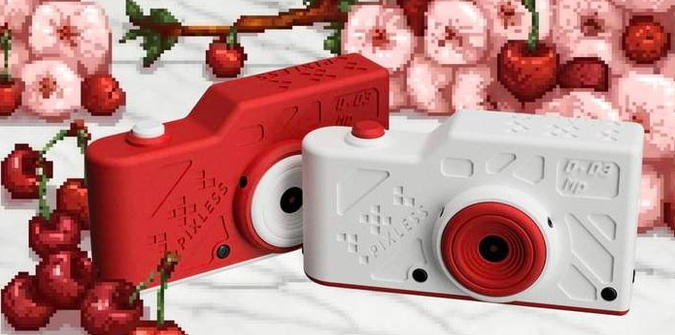
Physically, the Pixless feels more like a toy than a serious piece of photographic equipment.
Stern described the design as “chunky buttons and plastic that feels closer to a game controller than a camera.”
Yet despite its simplicity, the device is functional. It connects to a smartphone via Wi-Fi for image transfer and remote shooting, offers a standard tripod thread for more deliberate setups, and boasts a battery life that lasts for days of casual use. In this sense, it straddles the line between novelty and practicality.

Creative Features and Experimentation
What sets the Pixless apart are its built-in tools for experimentation. The camera allows users to load custom color palettes, which can completely change the feel of an image. One photograph might resemble a neon-lit cyberpunk scene with the right palette, while another could evoke the muted tones of a faded arcade screen. Stern noted that sometimes a palette enhances a shot dramatically, while at other times it ruins it entirely.
“Sometimes it works, sometimes it destroys the shot. That’s why you really need to experiment with lots of palettes before you find the right one,” he said.
Another key feature is adjustable dithering, which determines how subjects appear within the pixelated grid.
“The higher the dithering, the more defined the subject becomes,” Stern explained, adding that experimentation is crucial to finding the balance that works for each subject.
Combined, these tools turn photography into a game of trial and error, pushing users to accept mistakes as part of the creative process.


Editing Potential Beyond the Camera
Although the Pixless is designed to output playful, low-resolution images, Stern demonstrated that the creative process does not have to stop there. Each shot is saved in two versions: the stylized pixel-art rendering and a low-resolution companion file. This dual-output approach means photographers can continue experimenting in editing software, using tools such as Photoshop to adjust exposure, contrast, or color.
By extending the workflow beyond the device itself, the Pixless becomes more than a gimmick. It can be used as a generator of raw material, textures, portraits, or visual elements that can later be incorporated into larger projects. For artists and designers, this adds a layer of practical value to what might otherwise be seen as only a novelty item.

More Than a Toy?
At the heart of Stern’s review is the question of whether the Pixless should be considered a legitimate photographic tool or merely a quirky gadget. On one hand, its limited sensor and playful build quality make it difficult to compare with even the most basic modern digital cameras. On the other hand, its ability to spark creativity and encourage new ways of seeing gives it a distinct role that more advanced gear often lacks.
“It doesn’t pretend to be anything more than a toy camera, but it can actually teach you a lot about photography,” Stern concluded.
“For me, it’s both a tool and a gimmick. And that’s exactly why I’ll keep using it.”


Technical Specs
Beyond its playful aesthetic, the Pixless camera is built on a carefully considered technical foundation. The shell is 3D-printed in nylon PA12, a material chosen for its scratch resistance and durability, then pressure dyed for a smooth finish. The compact body measures only 3.31 × 1.81 × 0.91 inches (84 × 46 × 23 millimeters), making it remarkably portable.
Inside, the camera runs on an ESP32-S3 processor with 8 MB of flash and 4 MB of PSRAM. This configuration allows faster image handling than earlier prototypes. The imaging system is based on an OV5640 sensor, which provides greater dynamic range and color depth compared to earlier test models.
The Pixless also incorporates an advanced Texas Instruments battery management chip. This enables detailed monitoring of charge levels and health, with information displayed directly on the screen. Power is supplied by an 820 mAh battery, which charges over USB-C and supports mass storage transfer when connected to a computer.
Connectivity plays a major role in the design. Thanks to the ESP32’s built-in Wi-Fi, the camera can create a hotspot that allows users to connect via NFC. Once paired, a web server interface provides access to the image library, live view, remote shutter, palette uploads, and other settings, all without requiring a dedicated app. The choice not to build an app was deliberate, ensuring that the camera remains functional regardless of future software support.


Design Choices
The development team also placed emphasis on repairability and customization. Plans include releasing 3D design files so users can print replacement shells or modify the design themselves. Replacement parts such as the battery, OLED display, camera module, and even the main board are designed to be serviceable, making the Pixless unusual among digital cameras for its open, maker-friendly philosophy.
Early prototypes faced challenges, particularly with image quality and processing limitations when using off-the-shelf components like the ESP32-CAM and OV2640 sensor. These iterations informed the current design, which moves to custom boards and a more capable imaging system. The project also developed a custom JPEG compression algorithm, optimized to handle large blocks of uniform pixels. Unlike standard compression, this method is both lossless and highly efficient, tailored specifically to the Pixless’s pixel-art style.
Looking ahead, the creators are already considering a Pro Version with potential upgrades such as wider lenses, an RGB near-eye display, and manual controls. These features would expand the Pixless’s capabilities while keeping its distinctive pixel-art aesthetic at the center.
Resetting Expectations
In a market where every product launch is framed around speed, resolution, and technical superiority, the Pixless stands apart. It offers no megapixel milestones, no professional-grade specifications, and no claim to replace a traditional camera. Instead, it seeks to remind users that photography can be about experimentation, play, and rediscovery.
For photographers like Stern, many weary of the relentless race for sharper images and bigger sensors, the Pixless represents a kind of reset button, an invitation to strip photography down to its most basic elements and to rediscover the joy of simply pressing the shutter without knowing exactly what the result will be.
Pricing & Availability
The Pixless Camera Standard Edition is on Kickstarter, priced at $95 (€80) and comes in a black pressure-dyed nylon shell designed for durability and portability. Additional editions, including the Founders and Colorful Editions with custom color options, are also available for early backers.
Image credits: Pixless, Mathieu Stern
Disclaimer: Make sure you do your own research into any crowdfunding project you’re considering backing. While we aim to only share legitimate and trustworthy campaigns, there’s always a real chance that you can lose your money when backing any crowdfunded project. PetaPixel does not participate in any crowdfunding affiliate programs.
To hold projects accountable, all crowdfunding campaigns on which PetaPixel reports are financially backed with the lowest tier option in order to give the publication visibility into all backer-only communications. If a campaign owner acts in a manner inconsistent with its promises, PetaPixel will share that information publicly.