
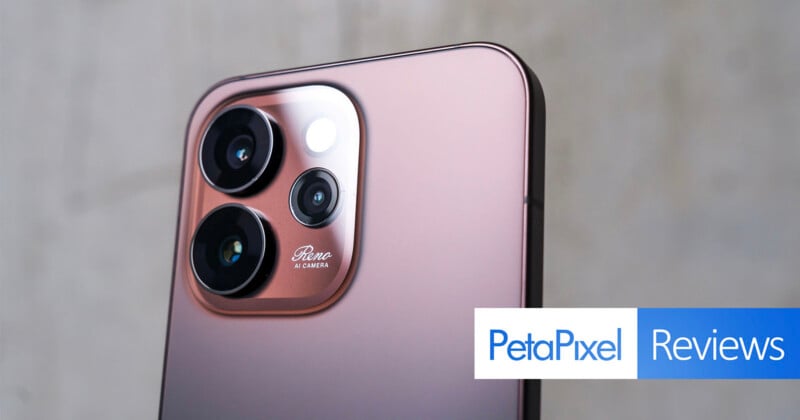
I had no idea what to expect with the Oppo Reno 15 Pro once I unboxed it and started setting it up. Billed as an “all-in-one creative partner,” the general premise is to impress with the images it captures, and using it as much as I have, I’m surprised at what it delivers considering the specs.
That this is a phone is actually besides the point because Oppo positions the Reno 15 Pro less on raw performance and more as an AI-driven camera phone for mobile photographers and social media types. It’s decidedly mid-range in both price (starting at $500 USD) and performance, but the camera carries the load in interesting ways.
‘Small’ but Sturdy
By today’s standards, a 6.3-inch AMOLED screen (2640 x 1216) is considered small, and I can see why such a form factor is appealing. The Reno 15 Pro doesn’t feel puny or devoid of screen real estate despite its smaller dimensions. Mind you, having not used previous Reno models, I can’t make any personal comparisons, but it feels just as premium as competitors making devices in a similar size.
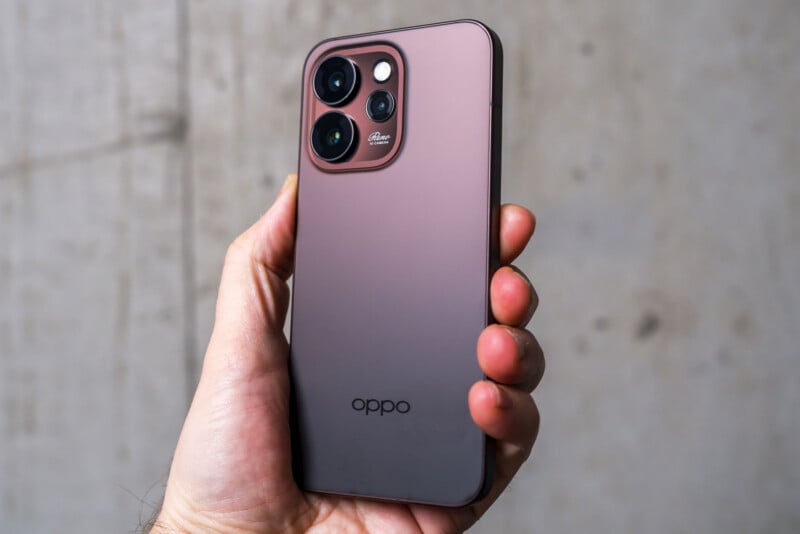
My dusk brown unit feels bolder than the black one and less flamboyant than the aurora blue variant out there. Oppo crams a 6,200mAh battery in this device, taking advantage of silicon-carbon tech to squeeze it all in. Suffice it to say, range anxiety isn’t a factor here, especially given it can handle up to 80W wired charging. I had this thing recharged through a OnePlus (North American) charger in 45 minutes upon being down to 10%. It even does 50W wireless charging, which is practically unheard of in the mid-range segment outside of OnePlus. Oppo is the parent company, so it’s not a big surprise.

I also appreciate that it doesn’t feel cheap. The IP66/68/69 dust and water resistance is a nice touch at this price point, as are things like screen brightness and using ColorOS as a proper Android overlay. The MediaTek Dimensity 8450 is surprisingly robust, and I like the idea of starting out with 12GB of RAM and 256GB of storage.
Frankly speaking, some of these specs are just unheard of on a device in this range. Granted, there is a regular Reno 15 (without the Pro suffix) that actually has a larger 6.59-inch screen and shares several of the same features, but they diverge a fair bit on the camera side.
Camera and Software Features
The camera array helps push the Reno 15 Pro into more premium territory. The 200-megapixel main camera (24mm equivalent with f/1.8 aperture) uses a Samsung Isocell HP5 Type 1/1.56 sensor, a newer one introduced in late 2025 that may or may not find its way into Samsung’s next mid-range phone. Interestingly, Oppo used the same HP5 sensor in the Find X9 Pro for the telephoto lens, yet chose to apply it to the main one here.

Isocell JN5 sensor, which is pretty small at Type 1/2.76. The f/2.8 aperture is tight by any telephoto standard, and it shows when trying to use it in low-light conditions. What helps is that Oppo applies much of its processing and color science from its flagships to the Reno 15 Pro to help the cause.

The 50-megapixel ultra-wide (16mm equivalent) is a bit more mysterious in using the GalaxyCore GC50F6 Type 1/2.88 sensor with an f/2 lens, though also with phase-detection autofocus. Oppo goes back to the Isocell JN5 for the 50-megapixel front camera, only with a wider focal length (18mm) and aperture (f/2.0).

These specs aren’t common for mid-range phones from the Big 3 in North America, including Samsung, which makes almost every image sensor in this device. We’ll see how the specs line up once the Galaxy A57 comes out, but I would be surprised if either the HP5 or JN5 makes it in.
AI is There When You Want it
Oppo offers the same Mind Space AI platform it provides on its most recent devices, along with a few other supporting features to go with it. The broader AI picture, however, is mostly driven by Google Gemini, which isn’t a bad thing since it also ties in with Mind Space. It doesn’t necessarily do that with the AI editing features in the Photos gallery app, but like modern Android phones today, you actually have two editing avenues. Go with either the one the phone’s own brand offers or kick it over to Google Photos and use what Gemini can do there.

One standout is the AI Studio app that uses cloud-based generative AI to create images from scratch or do wacky things with the ones you capture. Oppo incentivizes users to keep rolling with it by delivering 5,000 credits you can “claim” by just tapping the option in the app. The only catch is that you need to have or set up an Oppo account to unlock that. Once those credits dry up, you have to pay to get more, though Oppo will trickle some over as you keep using the app.
The templates feel almost endless, and since they rely so heavily on photos you’ve taken, particularly of yourself and other people, I have to admit there’s some fun to be had here. Results will vary, though, because the quality and precision of the images you upload impact what the AI can do. For example, profile shots get rejected while low-light portraits fare worse as starting points than well-lit ones. The photos you upload need to be clear, or else you end up wasting credits.
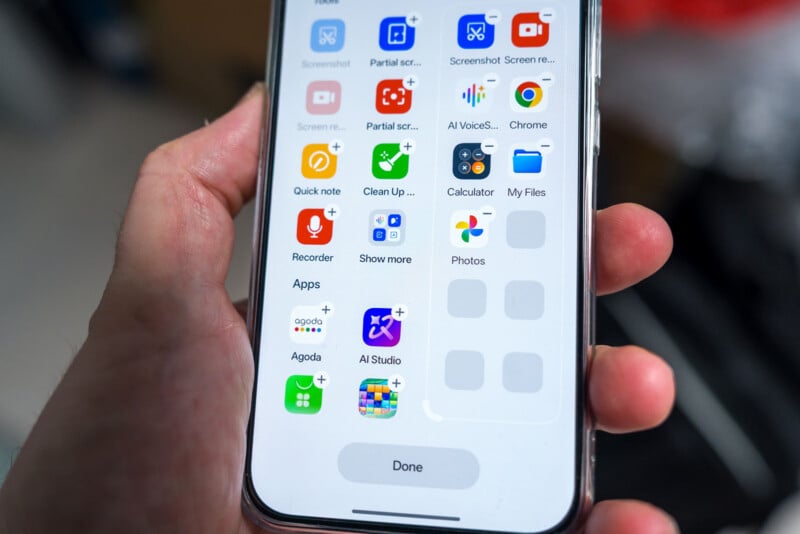
Beyond that, I just like ColorOS as a thoughtful Android overlay. From the Smart Sidebar to the notification system and Flux themes, Oppo manages to tiptoe onto the line of gimmickry without fully crossing it. It’s a clean interface that I think even some iOS users will find intuitive. Oppo is also guaranteeing five years of Android updates and six years of security updates.
Surprising Imaging Results
Oppo only lets Hasselblad come out for its flagships, so lacking that presence in color and processing gave me the initial impression that the Reno 15 Pro would struggle to pull out good photos. I came away pleasantly surprised, especially during a trip to Stockholm, where it became a dependable shooter for me. Testing it further in Toronto and Barcelona, it proves itself to be a solid mid-range camera array.


From the narrower streets of Stockholm’s Old Town to the rustic cathedrals of Barcelona, the main camera is an indication that Samsung’s HP5 sensor has real ability. Admittedly, I did turn to both the built-in gallery editing tools and Lightroom Mobile to work on a lot of these photos, but I never felt any of them were basically rescue operations. There were solid foundations to work with — and in a variety of circumstances — that made the Reno 15 Pro good fun to use.
Dynamic range is very balanced without Hasselblad’s influence, and while colors may not match the depth the Swedish brand is known for, looking at the library of 500-plus shots I took with this phone, I can’t find much fault given its price.


I had middling expectations for the telephoto and ultra-wide cameras, but they’re every bit part of what I’m talking about here. It’s definitely true that pixel-peeping reveals the limitations of their respective sensors, but that’s not a shocker to me. I expect that in this range. That’s why I fully concede many of these photos will look better on phone screens than on bigger laptop or computer monitors, for example. It’s just that photos look interesting coming out of this rear array, which is saying something for any mid-range phone.


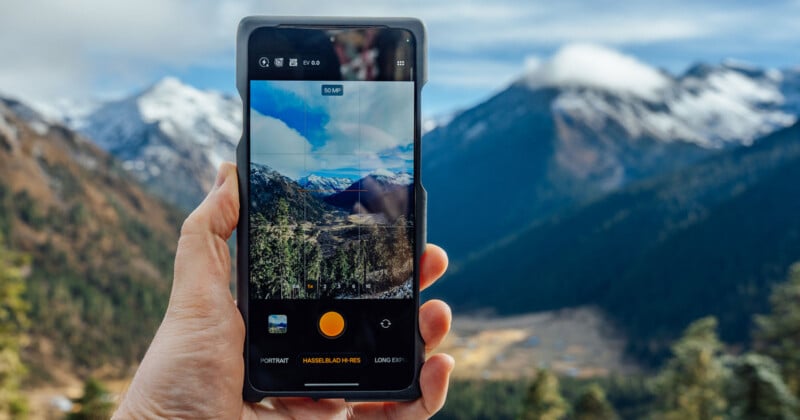
The film filters aren’t bad, nor are the focal effects primarily aimed at portraits, but applicable to anything you want to capture. It’s not the most extensive camera interface, given there’s no action mode or long exposure capability (apart from manual controls in Pro mode), but Oppo wisely includes the Underwater mode and a Text Scanner mode that’s great for copying and pasting text it reads from whatever document or sign you isolate in the frame.

I didn’t play around as much with video, but put it through its paces, and the story is very similar. Solid dynamic range and color, albeit with softer edges that take away some of the sharpness you’d like to maintain in any clip you record.
Oppo Reno 15 Pro Review: Standing Out
It’s hard not to like the Oppo Reno 15 Pro because it does plenty right beyond just the cameras. Battery life is outstanding for something its size, and performance runs smoothly in day-to-day situations.
Are There Alternatives?
Mind you, I do look at the Xiaomi 15T as an intriguing competitor because it uses a stronger chipset, has a bigger screen, and keeps the Leica effect in the mix. It’s a similar story with the Vivo V70, which does the same with its Zeiss partnership.


That tight competition is coming from China. Over here, the Google Pixel 10a feels limited by comparison, though stock Android and a (almost) full Gemini AI suite make it compelling for different reasons. I’m not optimistic Samsung will move the needle with the upcoming Galaxy A57, while the Nothing Phone (4a) Pro may prove to be a solid choice as the top Nothing phone for 2026. Meanwhile, Apple treats the lone rear camera on the iPhone 17e as an afterthought. There, too, the iOS experience is the big draw, though pricing can be frustrating when competitors offer more for less.
The Oppo Reno 15 Pro is available now, but you’ll have to buy it online from a vendor who will ship it to North America if you want it. Those vendors do exist, so options are available. Otherwise, you can find it in Europe, India, the Middle East, and much of Asia.
Should You Buy It?
Yes, because it can outclass others in the same price range. Plus, if you want a “smaller” phone, there aren’t a whole lot of those these days, either. Keep an eye on pricing as it tends to vary depending on where you find the Reno 15 Pro.